
What Coaches Get Wrong About Velocity Based Training (And Why It's Not Your Fault)
May 09, 2026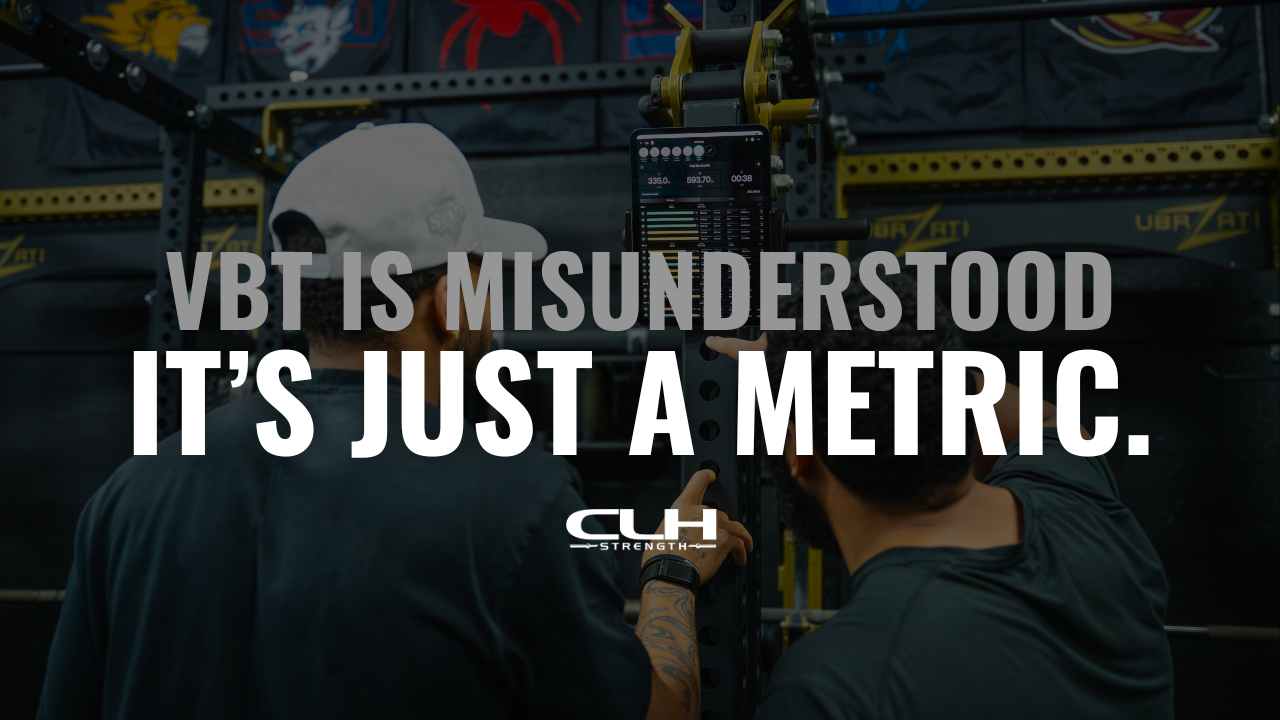
What Coaches Get Wrong About Velocity Based Training (And Why It's Not Your Fault)
If you've heard the term VBT and immediately written it off, or assumed it belonged to a certain type of program or a certain type of coach, you're not alone. And honestly, I don't blame you.
The way velocity based training gets talked about online has made it sound like a whole new way of training. A philosophy. A system. Something you either buy into completely or ignore entirely. I've seen it positioned as the future of strength training, as sports science for elite programs only, and as something that conflicts with the way you already do things. I've also seen it positioned as a methodology that promotes only lifting light weights.
None of that is accurate.
And once you understand what that means, a lot of the confusion around it goes away pretty quickly.
What VBT actually is
Let's strip this down to its simplest form.
Velocity based training, at its core, is the use of velocity as a metric during training. A device measures how fast a barbell, implement, or athlete is moving during a given exercise and gives you a number. That number represents speed of movement. That's the foundation. The same way that utilizing timing gates in sprinting gives you information about sprint speed.
It does not tell you how to program. It does not dictate your periodization model. It doesn't care whether you run a linear progression, a conjugate system, a block model, or anything else. It is a measurement tool, and a measurement tool only has one job: give you more information than you had before.
Think about a GPS in your car.
A GPS does not tell you how to drive. It doesn't decide what route is best or question your ability behind the wheel. It gives you more information about where you are, how fast you're moving, and what's ahead so you can make better decisions. You're still the driver. You're still making the calls. The GPS just makes sure you're doing it with more clarity.
A coach who uses VBT is not a different kind of coach. They're just a coach with more information.
The metrics explained simply
Here's where I want to slow down, because this is usually where coaches check out. The terminology can feel intimidating if you've never been exposed to it. But I promise, once you see what each number actually represents, it clicks fast.
Mean Velocity
Mean velocity is the average speed of the bar across the entire rep. Think of it like a running back's yards per carry average over a season. It doesn't tell you everything about every single carry, but it tells you a lot about what's consistently happening. When a running back's average drops mid-season, you start asking questions. Mean velocity works the same way. It gives you a consistent reference point to measure against.
Peak Velocity
Peak velocity is the fastest point reached during a rep. Think of this like a wide receiver's top speed on a route. It shows you their ceiling in that moment. Some athletes have tremendous peak velocity but struggle to sustain it. Some are more consistent throughout the movement. Knowing the difference helps you understand how an athlete is producing force and where they may have room to develop.
Velocity Loss
This one is arguably the most practical metric for daily coaching decisions.
Velocity loss measures the percentage of speed lost from your first rep to your current rep within a set. It is your fatigue tracker in real time. I also like to use it as a consistency marker.
Here's the analogy that makes this one land for most coaches. Think about a starting pitcher on the mound. In the first inning, he's sitting at 94 mph. By the sixth inning, he's down to 87 mph. The pitching coach doesn't wait for the hitter to get on base to know something has changed. The drop in velocity told the story first. That's the whole game. A good pitching coach manages that velocity loss to keep the pitcher effective as long as possible. It also indicates how long the pitcher can sustain based on the circumstances given.
Velocity loss in the weight room works exactly the same way. When an athlete's bar speed starts dropping significantly within a set, fatigue is accumulating. You can see it before technique breaks down. You can make a decision before the set becomes counterproductive. That's not sports science overcomplicating things. That's just paying attention with better tools.
Load-Velocity Profile
Over time, as you collect velocity data across different weights, you begin to map how fast an athlete moves at various percentages of their max. This becomes a fingerprint for that athlete.
If you've ever watched film on your athletes and noticed how their movement quality and speed change between lighter warm-up sets and heavier working sets, you already understand this concept intuitively. The load-velocity profile just puts numbers to what your eyes have been telling you for years.
Coaches who have been in the weight room long enough develop a feel for this without a device. VBT just makes it objective and trackable over time. The quantifiable nature also gives the coach a tool to use for maximizing intent.
VBT doesn't care what program you run
This is the part I really want you to hear.
VBT is not attached to any training philosophy. It is not a conjugate tool. It is not a linear periodization tool. It is not a "we only lift light weights" strategy. It is not something that belongs exclusively to sports science departments at Power Four programs. It works inside whatever framework you already trust and have built success with.
Think about the film room.
Every football coach, regardless of offensive scheme, watches film. A spread coach watches film. A wishbone coach watches film. A pro-style coach watches film. Nobody argues that film watching is a philosophy of football. It's a tool that gives coaches more information to work with inside their own system.
You don't have to change what you do. You don't have to rebuild your program or question everything you've built. You just get to see more of what's actually happening when your athletes perform within your system.
The coaches who feel threatened by VBT are often reacting to the way it gets marketed, not to what it actually is. When something gets labeled as the future or the next level, it implies that what you're currently doing isn't enough. That's not what I'm saying, and that's not what the tool is saying either.
What I am saying is that more information is always better than less. And a tool that gives you more information about your athletes, without requiring you to change your identity as a coach, is worth understanding.
What VBT tells you that you can't see
Coaches are already trying to read effort, fatigue, and intent every single day. You watch bar speed. You read body language. You know when something feels off before you can fully explain it. VBT just gives that a number.
Think about a thermometer.
You can walk into a locker room and feel that the energy is off. Something doesn't seem right with one of your athletes. But a thermometer tells you they're running a 101 degree fever. You suspected something. The thermometer confirmed it and gave you something to act on. Your instincts don't disappear. They get validated.
VBT works the same way. When your gut tells you that bar speed is slowing down, velocity data confirms or denies that feeling with a number. You become a more decisive coach, not a more robotic one.
Here's where this becomes practical on a day-to-day basis.
You can identify when a set is actually productive versus when fatigue has already taken over and additional reps are just accumulating unnecessary stress. On the flip side, you can know when a set is becoming stimulating, and not undershooting load. You can spot the athlete who is sandbagging and has more in the tank versus the athlete who is genuinely at their limit. You can make autoregulation decisions based on real data rather than guesswork. And you can track progress with any load, which means you don't have to push athletes to max effort tests as frequently to know if they're getting stronger.
Monitoring progress through velocity creates a more robust system that evaluates the physical and psychological outputs every single session. Your athletes train, you collect data, and the data tells you where things are trending. You no longer need to wait and test anything. The training is the test. And we test every time we walk into a weight room with the intention to get better.
The intent piece
Here's something every coach who has ever stood on a platform or walked a weight room floor has done.
You've told an athlete to be explosive. Move the bar fast. Attack the weight. Finish through the top.
Those are intent-based cues. You've been coaching intent your entire career. The problem is there's never been a clean way to quantify whether the athlete actually executed on that intent or just thought they did.
VBT closes that loop.
Think about the stopwatch in track and field.
Track coaches have always cared about speed. That's not new. But before the stopwatch, a coach could only watch and estimate. The stopwatch didn't change what track coaches valued. It gave them a way to measure what they already valued. The stopwatch made speed objective, trackable, and comparable over time. And now we have timing gates, GPS units, and ways to quantify speed changes over time.
The problem is that it gets confused with "the faster the better." In absolute terms, this is incorrect and misleading. Faster is always better when training within the constraints of the desired stimulus.
When an athlete knows their bar velocity is being measured, something changes. They compete against it. They want to see that number go up. It creates accountability to effort that no verbal cue alone can create consistently, especially over a long training cycle when motivation naturally fluctuates.
Intent-based coaching has always been a part of good strength and conditioning. VBT just gives you a way to measure it. A device like the Vitruve encoder makes this practical in any setting, from a high school weight room to a professional facility. You don't need a lab. You don't need a complicated setup. You clip it on the bar, it connects to your phone or tablet, and you have velocity data in real time.
Who VBT is for
Let me be direct here.
VBT is for any coach who wants more information about what's happening when their athletes train.
It does not require a specific certification. It does not require a graduate degree in sports science. It does not require you to throw out anything you currently do or change the way you think about programming.
If you care about your athletes moving with intent, recovering appropriately, and training at the right intensity on the right day, VBT gives you better information to make those decisions. That describes every serious coach I've ever been around.
The barrier to understanding VBT has never been the technology. It's been the way the conversation around it has been framed. When something gets associated with a certain type of program or a certain level of athlete, it creates an in-group and an out-group. That framing has kept a lot of coaches from exploring a tool that could genuinely help them.
Ignore the framing. Focus on the function.
VBT measures velocity. Velocity tells a story. That story makes you a more informed coach. The rest is just details.
VBT became complicated because of how it got marketed, not because of what it actually is.
At its core, it is a metric that tells you how fast something is moving. What you do with that information is still completely up to you. Your system, your philosophy, your athletes, your instincts as a coach. VBT doesn't replace any of that. It just helps you see it more clearly.
- The GPS doesn't drive the car.
- The thermometer doesn't treat the fever.
- The stopwatch doesn't run the race.
- The film doesn't call the play.
But every great coach uses every tool available to them.
If you have any deeper questions about VBT, please reach out to me. I'd love to discuss.
PS. Check out my VBT Playbook for how I implement VBT in a team setting with simplicity without slowing down the training session [VBT PLAYBOOK]
Enjoy this post? Share it to your social media and tag me in it!
Check out our products by clicking here 👇🏻
Stay connected with news and updates!
Join our mailing list to receive the latest news and updates from our team.
Don't worry, your information will not be shared.
We hate SPAM. We will never sell your information, for any reason.
