Stop Guessing.
Start Coaching
With the Bar Speed System That
Actually Works in Your Room.
A simple, coach-first framework for turning bar velocity into real training decisions — without turning your weight room into a physiology lab.
- "We have a VBT device but nothing in training is actually changing."
- "My staff can't run it consistently without me there."
- "I don't want another certification — I want something usable tomorrow."
Works with any device · Any program
Fails Most
Coaches
-
01
They treat it as a 1RM estimator
Test. Chart. Build a profile. Then nothing in training actually changes. VBT added cost and complexity with zero new decisions made because of the data.
-
02
They copy-paste generic velocity zones
Zones borrowed from lab research, built for someone else's population, applied to your room. When athletes don't match the chart, they blame VBT — not the borrowed assumptions.
-
03
They make it too complex to run live
12 metrics. 4 spreadsheets. A lecture required before every set. The room stops moving and the coach becomes a full-time tech babysitter instead of a coach.
-
04
They collect data without changing behavior
Same program. Same loads. Same decisions. The device sits on the bar looking expensive — because there's no system connecting the numbers to what happens next.
Three Modes.
One System.
No Guessing.
Every session runs through exactly one mode. You always know what you're doing with the numbers — before the first set loads.
Keep your existing program exactly as written. Attach a device. Let athletes see bar speed after every rep or set. No load changes yet — just exposure to the truth of how fast they're actually moving. Intent goes up immediately. This is where every room should start.
Attach a minimum velocity band to any loading progression. Above the floor — follow the plan. Inside the floor — stop climbing. Below it — drop load. Perfect for ascending schemes, younger athletes, and any environment where VBT is a safety net more than a steering wheel.
Give the athlete a velocity range — e.g. 45–55. Flat set-rep scheme. Set average MPV vs. the frame tells you exactly: keep the load, earn a jump, or take a redemption set. The jump table tells you how much to change. No subjectivity — the system decides.
Stop Chasing
1RMs.
SpeedMaxes track the heaviest load lifted at three velocity thresholds — giving you a complete picture of the strength-speed curve instead of a single number that only reflects one day.
Heaviest load ever lifted at or above 0.30 m/s. Heavy, near-failure — the force end of the curve.
Heaviest load at or above 0.50 m/s. The strength zone where most training volume belongs.
Heaviest load at or above 0.80 m/s. Peak power territory — where sport performance lives.
VBT Rewrites
What "Strong" Means.
Two case studies from inside the playbook that will change how you evaluate athletes — and why a 1RM alone doesn't tell the whole story.
The "Weak" Powerhouse
Offensive Lineman
6'4", 285 lb. Multiple D1 offers. Dominated every Friday night. His best bench was 295 lb — and everyone said it wasn't enough for his size. Traditional metrics called him weak. VBT told a completely different story: at 205 lb in the 80–90 MPV range, he was producing more power than anyone else in the room. His long arms and extended ROM made max-effort singles look slow. His power zone was elite.
The Elastic Hooper Who
"Needs to Get Stronger"
Lean. Bouncy. 10-foot broad jump. Dunks violently. In the weight room, everyone said the same thing: he just needs to get stronger. Box squat profiling told a different story — his 0.30 SpeedMax sat around 1.7× bodyweight, which was fine for a guard. But his power output at 1.25× bodyweight was elite. His on-court explosiveness matched his VBT power profile exactly. Forcing a grind-first program would have fought his biology.
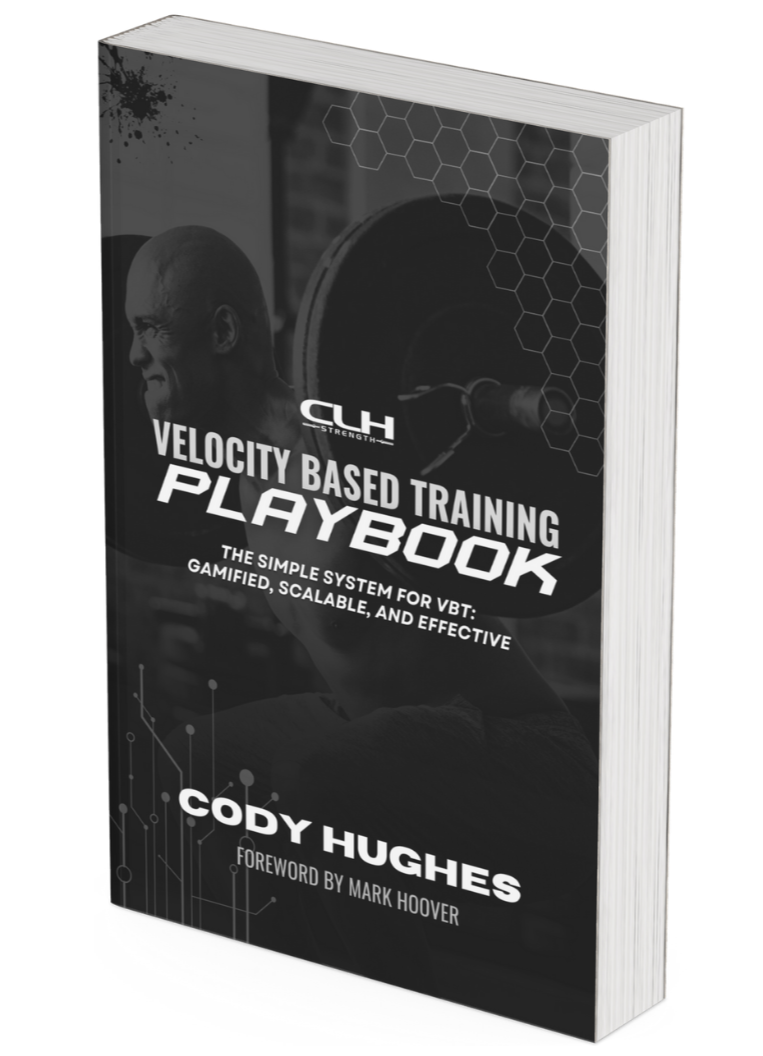
86 Pages.
Everything You Need.
The complete chapter structure — no filler, no research summaries, no lab jargon.
- What VBT is — and what it is not
- The metrics that actually matter (MPV, set average, ROM)
- The load–velocity relationship as a coaching framework
- Device setup and movement standards
- The 5 mistakes coaches make with VBT
- The 3 modes: Feedback Only, Floor, Frame
- Load–Velocity Profiles — building the map
- SpeedMaxes at 30, 50, and 80 explained
- How SpeedMaxes update automatically through training
- Percentages and LVP e1RM — the right foundation
- Strength with VBT — frames, flat sets, real examples
- Power with VBT — box squat, trap bar, ballistic work
- Off-season vs in-season VBT adjustments
- Running VBT in a 35-, 60-, and 90-minute window
- When numbers don't make sense — troubleshooting guide
- 10-step Quick Start Checklist
- Glossary and coach cheat sheets
- SpeedMax evaluation charts for trap bar, squat, bench
- Set/rep scheme chart with velocity frame reference
Answered
Honestly.
Yes. The entire system is designed for limited equipment and large groups. One VBT-tagged primary lift per session is all you need. The playbook tells you exactly which lifts to prioritize so you get the most signal with the least hardware.
Not at all. The system is built to layer on top of what you already do. Velocity validates and refines percentages — it doesn't replace them. The pipeline is: Profiles → Percentages → Velocity → Decision.
The playbook includes a full communication system so athletes compete with numbers without needing a physiology lesson. Decimals become whole numbers. Charts stay with the coach. Athletes just see a score and try to beat it.
The system is device-agnostic. If your device outputs set average MPV, rep-by-rep velocities, and ROM, you can run this playbook. Cody personally uses Vitruve — but every mode and framework transfers to any platform.
Chapter 14 is dedicated entirely to this. One VBT lift per session is the rule in short windows — and it fits inside any schedule that already has a primary lift. More time means more coaching, not more tags.
Both. It starts from scratch and builds fast. Experienced coaches will immediately have sharper frameworks for decisions they're already making. Coaches newer to VBT will have a clear, no-assumption roadmap from day one.
Start Using Bar Speed
Tomorrow Morning.
One PDF. Three modes. A system your staff can actually run — starting with the first set of your next session.
Works with any VBT device · Any sport · Any setting
Built for real weight rooms, not research labs.